How do Integrated Structures and Software Tools Support the Management of the Effects of Project Complexity?
DA
Dr. Dimitris N. Antoniadis
DANTON ProgM Ltd | London, UK
December 2025
The sophisticated management of complexity in modern projects relies heavily on establishing clear, integrated systems. The author draws from several sources to demonstrate that integrated structures and software tools support the management of the effects of project complexity. Properly used they primarily provide a "single source of truth" and control the dynamic interactions and information flows that otherwise lead to uncertainty and issues.
The author provides below a comprehensive breakdown of how integrated structures and software tools achieve this.
Managing Project Complexity through Integrated Structures and Software Tools
Integrated structures and supporting software are essential mechanisms used by project control to deal with the effects of inherent complexity in projects (Antoniadis, 2018). Complexity itself is viewed as the natural consequence of the interaction of dynamic relationships (Antoniadis, 2018).
1. Integrated Structures as the Core Complexity Management Tool
The systematic application and standardisation of project structures are fundamental to managing complex interactions and ensuring information integrity throughout the project lifecycle (Antoniadis, 2018).
The Foundational Role of Breakdown Structures — key structures include:
-
1
Work Breakdown Structure (WBS): The WBS serves as the core structure for integration, ensuring fundamental clarity and mitigating future problems. A proper WBS is critical because it must contain all approved scope. The lowest levels of WBS elements should be unique to clarify precisely which scope and cost belong to each work package and control account (Antoniadis, 2018).
-
2
Managing Interfaces through the structures: Project control manages complexity arising from interfaces by combining primary structures to define relationships between different reporting elements (Antoniadis, 2018). For instance, combining WBS and OBS creates the Responsibility Assignment Matrix (RAM) (APM, 2010). Combining WBS and CBS creates the link between work packages and cost elements, enabling much improved monitoring.
-
3
Enforcing Constraints (Downward Causation): The establishment of project structures such as the WBS manages complexity through "downward causation" — a complexity characteristic that influences the structure of data (Antoniadis, 2009 & 2018). This process puts all project practitioners in a "loose straitjacket" by having higher-level structures set constraints on the parts, thereby regulating boundaries and reducing external influencing factors that exacerbate complexity.
-
4
Holistic Reporting and Roll-up:Other structures, such as the Cost Breakdown Structure (CBS), Organisational Breakdown Structure (OBS), and Risk Breakdown Structure (RiBS), use standardised coding which allows information to be grouped and "rolled up" efficiently to various management and strategic levels (Antoniadis, 2018). The RiBS, for example, is primarily used in client organisations where risks are rolled up to asset levels and potentially combined with other company risks (Antoniadis, 2018).
This structured approach also allows for the horizontal interrogation of information for specific departments, such as Finance (Antoniadis, 2018).
2. Integrated Software Tools for Data Integrity and Insight
Project control processes rely heavily on integrated software tools to ensure accuracy and minimise the negative impact of information flows, which are often sources of project complexity (Antoniadis, 2018).
Establishing the "Single Source of Truth"
Integrated project control software systems aim to establish data that serves as a "single source of truth" for the project (Association for Project Management, 2023).
-
1
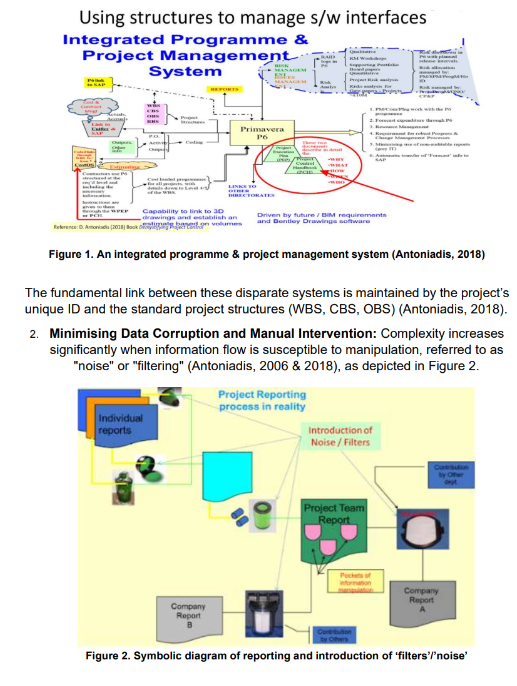
Software System Integration and Linking: An Integrated Programme & Project Management System (see Figure 1 below) often uses, as a core, the scheduling software and links it with the Enterprise Resource Planning (ERP), estimating and cost/contract management tools (Antoniadis, 2018).
The fundamental link between these disparate systems is maintained by the project’s unique ID and the standard project structures (WBS, CBS, OBS) (Antoniadis, 2018).
-
3
Integrated systems minimise manual interventions and reduce the need to export and manipulate data in unofficial systems, such as spreadsheets, often referred to as "grey IT" (Antoniadis, 2006 & 2018). Data that has been exported is generally not considered "robust" and is at risk of manipulation and errors. Avoiding the duplication of effort caused by fragmented data systems is critical because duplication is a demotivating factor and a threat to project delivery (Antoniadis, 2018).
Earned Value Analysis (EVA)
Enabled when cost, scope, and schedule data are properly linked, providing a holistic measure of performance (APM, 2010 and Antoniadis, 2018).
Building Information Modelling (BIM)
Future and current BIM requirements depend on integration of scheduling software tools with estimation and design data, often linking to 3D drawings (Antoniadis, 2018).
3. Enabling Timely and Informed Decision-Making
The ultimate function of integrated structures and software tools is to transform raw project data into actionable intelligence, enabling management to respond effectively to complexity.
Project control is defined as the application of knowledge, skills, tools, and processes to generate, from integrated data, the right information that will enable the right decisions to be made at the right time to manage project scope, time, cost, and risk (APM, 2010).
-
1
Providing Answers and Corrective Action: Project Controls are critical for setting and maintaining the deployment baseline. They provide answers at any given time regarding what was planned versus actual progress, the reasons for deviations, the forecast for completion, and the corrective actions required to bring performance back on track (Antoniadis, 2018).
-
2
Governance and Assurance: Project control processes operate within a framework of project management governance (APM, 2006). Integrated planning culminates in the creation of the Deployment Baseline (or Performance Measurement Baseline, PMB) (APM, 2019 and APM, 2010). This baseline provides crucial assurance to the project sponsor and client, ensuring accurate, timely reporting needed for formal go/no-go decisions at defined decision gates.
-
3
Holistic Interface Management: Effective controls allow project professionals to manage the effects of complexity by thinking holistically and understanding precisely where interfaces exist and how they affect delivery (Antoniadis, 2018). This requires consistent and continuous communication with all interfacing disciplines, such as Finance and Procurement.
-
4
Identifying "Pathogens": Setting up proper structures early in the project lifecycle allows the team to be proactive in mitigating errors — sometimes referred to as "pathogens" that can cause major disruptions later (Busby & Hughes, 2004).
Closing Remarks
The management of project complexity necessitates a disciplined and integrated approach that, in addition to other actions, requires combined standardised structural frameworks with advanced software systems. Use and integration of structures such as the WBS, CBS, OBS, as well as other structures, provides the foundation for clarity, accountability, and consistency throughout the project lifecycle.
When supported by integrated software tools, these structures enable the establishment of a single, authoritative source of data, thereby reducing fragmentation and mitigating risks associated with information distortion. This synergy facilitates accurate reporting, timely decision-making, and the application of advanced control techniques, including EVA and BIM.
Furthermore, it strengthens governance and assurance processes by ensuring that performance baselines are maintained and deviations promptly addressed.
In essence, integrated structures and software tools do not merely support project delivery; they underpin the systematic transformation of complexity into actionable intelligence. Their adoption is therefore essential for achieving transparency, resilience, and efficiency in contemporary project environments.
References
Antoniadis, D. N., Edum-Fotwe, F.T., Thorpe, A. (2006). Project reporting and Complexity. In Boyd, D. (Ed) Procs 22nd Annual ARCOM Conference. UCE, Birmingham University, Vol 1. Pp 123–133.
Antoniadis, D. (2009). Managing Complexity in Project Teams. PhD Thesis. Loughborough University, UK.
Antoniadis, D. (2018). Demystifying Project Control. Amazon Publishing.
APM (2006). APM Introduction to Project Control. Princes Risborough.
APM (2010). APM Planning, Scheduling, Monitoring and Control Guide. Princes Risborough.
APM (2019). APM Body of Knowledge, 7th edition. Princes Risborough.
APM (2023). Senior Managers' Guide to Project Controls. Princes Risborough.
Busby, J.S. and Hughes, E.J. (2004). Projects, pathogens and incubation periods. International Journal of Project Management, Vol. 22(5), pp. 425–434.
Dr Dimitris N. Antoniadis PhD MSc BEng(1st) CEng FAPM FCMI MIMechE, based in UK, has 35+ years' experience in Programme and Project Management positions, having covered project phases from concept to handover and operation/maintenance.
He is currently Director in the Programme, Project Management and PMO with DANTON PROGM, technical advisor to Novacept and has set up the BSc in Project Control that is currently delivered by the partnership between London Metropolitan College and the University of West London.
He has held Senior Management posts in major utilities, infrastructure and construction organisations delivering programmes of works ranging from £250M to £3.2Bn. As Head of Programme Management Office (PMO) he has set up and run the departments within challenging partnering environments, setting up all the processes from governance to reporting. He has also led / co-led major business transformation programmes for Client organisations in UK and abroad, integrating project management software tools with ERP systems.
He is the author of the book Demystifying Project Control; contributed chapters in books on complexity, leadership and other project management topics and has written a number of journal and conference papers. He has been a guest speaker at UK Universities as well as International conferences on various project management topics.
He was awarded the PhD, from Loughborough University, UK, on the subject of Managing Complexity in Project Teams, where he developed a framework for managing the effects of complexity on projects.
How to cite: Antoniadis, D. N. (2025). How do integrated structures and software tools support the management of the effects of project complexity? commentary, PM World Journal, Vol. XIV, Issue XII, December.

 Australia