
 Australia


1. Introduction — Reassessing the Foundations of Risk Management
In an era characterised by increasing project complexity and interdependence, the demand for more improved and dynamic risk management methodologies has never been greater. Traditional approaches, while foundational, often fall short in capturing the full, multi-dimensional nature of modern risks. This paper builds upon established risk theory to propose a novel, vector-based framework that integrates the critical dimension of time. By reconceptualising risks as dynamic vectors rather than static points, we can achieve a more nuanced understanding of not only their potential impact but also the speed at which they approach and escalate.
The core practice of risk management is rooted in understanding and addressing uncertainty. The Association for Project Management (APM) Body of Knowledge (2019) provides a concise and powerful definition of risk: “The potential of an action or event to impact the achievement of objectives.”
The fundamental purpose of risk management is to proactively assess and manage this uncertainty before potential events materialise. It is a systematic process designed to optimise success by minimising threats and maximising opportunities. By predicting what might deviate from the plan, project leaders can implement actions and responses to reduce uncertainty to an acceptable level, if not minimised completely.
The traditional risk management process operates as a dynamic, cyclical flow, ensuring that risk analysis remains current as new knowledge emerges. This process involves several key stages (APM, 2019):
- Initiate: Establishes the strategy, roles, and scope, culminating in the creation of a Risk Management Plan.
- Identify: Involves finding and documenting all potential risk events that could affect the project.
- Assess: Increases the understanding of each risk’s probability and potential consequences to inform decision-making.
- Plan Responses: Determines the appropriate actions to address the identified risks.
- Implement Responses: Puts the planned actions into effect and monitors their efficacy.
At the heart of this process lies a fundamental dichotomy in how risks are managed. This separation of concerns is crucial for targeted and effective risk response:
- Likelihood is managed through the implementation of robust governance and control mechanisms.
- Impact is managed through the execution of specific mitigating actions designed to lessen its severity.
While this structured approach has served projects well, its reliance on conventional, two-dimensional assessment tools presents significant limitations. These tools often struggle to represent the combined impacts of cost and time or to capture the urgency of a threat. It is this gap that the author attempts to address in order to move towards a more robust, three-dimensional framework capable of modelling risk with greater fidelity, supported by mathematical concepts.
2. Evolving Beyond Flatland: The 3D Risk Matrix Methodology
Accuracy in visualising and assessing complex risks is a supporting and valuable mechanism for any project team. However, conventional two-dimensional (2D) methodologies have faced growing criticism for their inability to capture the multifaceted nature of modern project threats. In this section the author critiques these shortcomings and introduces the 3D Risk Matrix as a significant advancement, providing a more comprehensive spatial understanding of risk.
The primary concerns with traditional 2D risk methodologies are numerous, leading to subjective outcomes and a lack of confidence in the process among workshop participants and stakeholders. Key criticisms include:
- Lack of visualisation & communication: Flat matrices fail to provide an intuitive picture of the overall risk landscape.
- Inability to combine Cost and Time impacts: Risks are typically assessed against either cost or time, but rarely both simultaneously, which is an inaccurate reflection of reality.
- Reliance on an arbitrary, sometimes subjective approach: The process feels and, on most occasions, is arbitrary, influenced and relies on simple integer multiplication.
- Human factor interventions – strong characters imposing their opinion: The assessment can be skewed by dominant voices rather than objective analysis.
- Lack of flexibility in ranking: The use of integers obstructs a more granular and realistic assessment, as participants often wish they could use decimal values to better position a risk.
To overcome these issues, the 3D Risk Matrix was developed (Antoniadis & Thorpe, 2003). The proposed model expanded the traditional framework by positioning risks within a three-dimensional space defined by three basic axes:
- Likelihood (L) in the ‘x’ direction
- Impact on Time (IoT) in the ‘y’ direction
- Impact on Cost (IoC) in the ‘z’ direction
This approach transforms a risk assessment from a simple product of two variables into a coordinate point within a 3D cube. This allows for a more granular and simultaneous consideration of likelihood, impact on time and impact on cost, as shown below in Figure 1.

As described in Antoniadis & Thorpe (2003), a core innovation of this methodology is the concept of “Risk Pyramids.” Rather than treating risks as isolated points, the model recognises that they can exist in the space between the integer coordinates. Pyramids are formed by connecting adjacent coordinates within the main cube, creating discrete zones of risk priority. This geometric solution allows for the use of decimal values, providing a more nuanced prioritisation. The breakthrough lies in establishing that position, not just magnitude, dictates priority (see Figure 2). For example, a risk assessed at (L = 2.5, IoC = 2.8, IoT = 1.8) yields a product of 12.6 (Antoniadis & Thorpe, 2003). In a 2D system, this might be deprioritised against another risk with a higher product. However, its coordinates place it squarely within a high-priority pyramid, correctly identifying its severity in a way that simple multiplication cannot. Figure 2 below presents, in a 3 x 3 matrix, how the individual blocks are identified and then how these are separated into pyramids. A more detailed description and analysis of this can be found in Antoniadis & Thorpe (2003).

The primary advantages of this methodology (Antoniadis & Thorpe, 2003) are twofold: a profound enhancement in visualisation and a significant increase in analytical granularity. By enabling participants to visualise risks in a 3D landscape, the model improves communication and stakeholder buy-in. Quantitatively, it improves the process of identifying major risks by focusing attention on specific high-priority pyramids, thereby accelerating the workshop process and allowing for more focused mitigation planning. The location within a pyramid provides a more accurate indicator of severity than a simple product score, moving the practice from a qualitative art toward a more quantitative science.
At the ISEC-02 Conference in 2003, the author presented a case study, see Figure 3 below, of applying the 3D Risk Matrix (3DRM) methodology on an airport Fuel Management Unit. Having conducted a workshop to identify the risks using the two methodologies, the author demonstrated that with the 3DRM approach, amber risks should have had a higher risk level(s). Figure 3 below also demonstrates how a number of ‘red’ risks should have been ‘amber’ and at least two ‘amber’ risks should have been ‘red’.

While the 3D matrix provides a vastly superior spatial understanding of risk, it still treats each threat as a static, fixed point in that space. This perspective, though an improvement, overlooks a critical variable: the speed at which a risk can manifest and cause harm. This sets the stage for the next step(s) in risk theory - the integration of time as a dynamic element.
3. The Missing Dimension: Introducing the Theory of Risk Velocity
To manage risk proactively, it is not adequate to understand if a risk might occur and what its impact might be. The team and the PM need to understand the speed at which it can affect a project. This temporal dynamic, often overlooked in traditional assessments, is the key to differentiating between a distant threat and an imminent crisis. The concept of Risk Velocity provides this essential temporal dimension, transforming risk analysis from a static snapshot into a dynamic forecast.
Risk Velocity refers to the speed at which a risk event materialises and begins to affect a project’s objectives. It adds a critical time-based component to the conventional dimensions of probability and impact, helping project managers gauge the urgency of a required response.
This concept can be deconstructed into two distinct and equally important components, each measuring a different phase of the risk’s lifecycle:
- Lead Time Velocity (LTV) or Time To Cause (TTC): This is the speed at which a risk can materialise. It measures the period between the present moment and the point at which the risk event is likely to occur. It answers the question: How fast is the risk approaching? (Tattam, 2014).
- Impact Time Velocity (ITV) or Time To Impact (TTI): This is the speed between the risk event occurring and the point where its full consequences are felt. It measures the rate at which damage escalates after the risk has materialised. It answers the question: Once it happens, how fast will the damage spread? (Tattam, 2014).
The strategic implication of this distinction is profound. Risk Velocity provides a measure of urgency, allowing project managers to differentiate between a high-impact, low-velocity risk that allows for careful planning and a lower-impact but high-velocity risk that demands an immediate mitigating response. Without considering velocity, a team might misallocate resources by focusing on a large but slow-moving threat while ignoring a smaller but faster one that could derail the project much sooner.
Traditional attempts to quantify velocity within a 2D framework are still experimental and do not consider the element of time ‘t’. Some conceptual attempts are made, such as the formula:
This commits a category error by attempting to sum or add qualitatively different measures (probability and velocity), failing to capture the distinct, orthogonal nature of the LTV and ITV phases.
To accurately model these two distinct velocities and their interaction with the three spatial dimensions of likelihood, cost, and time, a more advanced analytical tool is necessary. Vector mathematics offers the ideal framework for this task, enabling us to represent and analyse these dynamic forces within a cohesive three-dimensional space.
4. A New Synthesis: Reimagining Risks as Vectors in 3D Space
In this section the author will synthesise the spatial awareness of the 3D Risk Matrix with the temporal dynamics of Risk Velocity. By moving beyond a conception of risks as static coordinates, we can reimagine them as vectors, mathematical objects which possess both magnitude and direction. This paradigm shift provides a powerful new language for describing and analysing the dynamic nature of threats.
The author, based on the previous analysis done by Antoniadis & Thorpe (2003), proposes that a risk located at coordinates (L, IoT, IoC) within the 3D cube can be represented as a position vector. This vector originates from the point of zero risk, <0, 0, 0>, and terminates at the risk’s coordinates. For example, for a risk with L = 2, IoT = 3 and IoC = 3, the risk will terminate at point C and have coordinates <2,3,3>. This primary vector, which we will call OC, represents the path the risk takes as it materialises. Once the risk occurs at point C, a secondary velocity vector, CC1, can emerge, representing the escalation of its impact over time. This is presented in Figures 4a & 4b below. In addition to vector CC1 and if a secondary threat is to occur, this will be represented by another vector CD.


This shift from a scalar (a simple number, like a product score) to a vector representation has profound implications. A vector inherently contains richer information about the risk it represents:
Magnitude: The length of the vector provides a single, quantifiable measure of the risk’s overall severity, calculated from its likelihood, cost, and time components.
Direction: The orientation of the vector in 3D space indicates the nature of the risk’s impact. A vector oriented primarily along the y-axis (Impact on Time) represents a risk whose primary consequence is possibly a schedule delay, whereas one oriented along the z-axis (Impact on Cost) signifies a budget threat. A vector between them, such as <1, 3, 3>, indicates a threat with equally severe cost and time impacts but a lower likelihood.
This vector-based framework provides the necessary mathematical foundation to model Lead Time Velocity (LTV) and Impact Time Velocity (ITV) not as abstract qualitative scores, but as distinct, quantifiable vectors. The primary threat vector OC models the LTV, describing how quickly the risk moves from a state of potential to actual occurrence. Theoretically, this will be moving from the origin with coordinates <0,0,0> to point ‘C’ with coordinates <1,3,3>. The secondary vector CC1 models the ITV, describing how rapidly the consequences escalate after the event.
To fully unlock the predictive power of this new model, we must first establish the underlying mathematical principles that govern vectors in 3D space. By understanding the vector equation of a line, we can begin to model the trajectory and velocity of risks with unprecedented analytical rigour.
5. The Mathematical Framework: Applying Vector Theory to Risk Dynamics
To operationalise the vector-based risk model, a foundational understanding of vector mathematics is essential. This section demystifies the core principles, focusing on the vector equation of a line. This equation, a staple of physics and geometry, becomes a remarkably powerful tool for risk analysis when one of its key parameters is reinterpreted in the context of project management.
The general formula for the vector equation of a line in 3D space is:
Each component of this equation has a specific meaning:
- \( \vec{r}(t) \): The position vector of any point on the line.
- \( \vec{r}_0 \): The position vector of a known starting point on the line (e.g., the origin).
- \( \vec{v} \): The direction vector of the line, which defines its orientation and slope.
- \( t \): A scalar parameter that “scales” the direction vector, allowing one to move along the line.
The pivotal argument for applying this to risk management lies in the interpretation of the parameter ‘t’. In pure mathematics, ‘t’ is merely a scalar. However, in physics/kinematics as also in the context of project management, which operates entirely within the dimension of time, ‘t’ is not just a scalar but should be interpreted as a time variable, measured in units such as hours, days, or weeks. Where traditional risk scores are dimensionless products, the vector equation \( \vec{r}(t) = \vec{r}_0 + t\,\vec{v} \) embeds the risk within the dimension of time, making its growth or decay a measurable function of the project schedule.
This interpretation has a critical impact. It transforms the static equation of a line into a dynamic model of movement. For example, consider a risk vector originating from <0, 0, 0> with a direction vector of <2, 3, 3>. Its equation becomes \( \vec{r}(t) = \langle 2t, 3t, 3t \rangle \). If we allow time t to slip from 1 unit to 2 units, the risk’s coordinates double from <2, 3, 3> to <4, 6, 6>. The use of vectors immediately and visually emphasises the escalating effect that the passage of time has on the risk’s magnitude.
The figures below (Figures 5a & 5b) visually demonstrate this principle. As time (t) doubles from 1 to 2, the risk’s position vector moves from r(1) = <2,3,3> (see Figure 5a) to r(2) = <4,6,6> (see Figure 5b), further from the origin along the same trajectory, graphically representing the increase in its overall magnitude.
Explanation:
Using vector equation \( \vec{r}(t) = \vec{r}_0 + t\,\vec{v} \) with r0 coordinates <0,0,0> and introducing coordinates for vector ‘v’ as <2,3,3> Figure 5a presents this in 3D.

What we are seeing:
- Because \( \vec{r}_0 = 0 \), the curve is a straight line through the origin in the direction of \( \vec{v} = (2,3,3) \).
- Any point on the line is \( \vec{r}(t) = (2t, 3t, 3t) \).
Overlaying on the above and for the same vector but for an additional point where t = 2, we have Figure 5b.

As seen in Figures 5a and 5b, if the initial starting point r0 is the origin <0, 0, 0> and the direction vector v <2, 3, 3>, then the position vector ‘r’ at ‘t=1’ is <2, 3, 3>, but if the time ‘t’ slips to ‘t=2’, the position vector immediately doubles in size to <4, 6, 6>. This clearly shows how the use of vectors emphasises the effect of the time element on the risk (LTV).
With this mathematical framework established, where risks are vectors and the parameter ‘t’ represents time, it is now possible to construct a comprehensive model. This model will define Lead Time Velocity (LTV) and Impact Time Velocity (ITV) as specific, interacting vectors that together describe the full dynamic lifecycle of a risk within the 3D risk space.
6. The Dynamic Risk Velocity Model: A Proposed Concept
This section represents the culmination of the preceding concepts, formally defining a complete, dynamic risk model. This framework is comprised of two key vectors that together capture the temporal journey of a threat: the Lead Time Velocity (LTV) vector, which describes its path to occurrence, and the Impact Time Velocity (ITV) vector, which models the escalation of its consequences.
6.1. The Lead Time Velocity (LTV) Vector: The Path to Occurrence
The Lead Time Velocity (LTV) is represented by the primary threat vector OC. This vector originates at the point of zero risk, <0, 0, 0>, and terminates at the coordinates of the identified risk C = (L, IoT, IoC) within the 3D cube. The vector OC embodies the speed and trajectory at which a potential threat approaches its point of materialisation. Its magnitude indicates the overall severity, while its direction reveals the nature of the impending impact, as shown in Figure 6 below, which depicts the primary threat vector OC and the subsequent Impact Time Velocity vector CC1.

To enable targeted risk management, the LTV vector OC can be deconstructed into its component vectors on the 2D planes defined by the primary axes (see Figure 7a & 7b below). As shown in the figures below, these components isolate the LTV, risk velocity in relation to pairs of variables. For example, the component vector OCT/C, in the plane defined by IoT & IoC, represents the speed of the LTV threat as a combination of its Impact on Time and Impact on Cost elements.


This deconstruction provides a direct link between the vector model and practical risk management actions. This vector-based deconstruction allows, for the first time, a direct mathematical and visual link between specific management actions (controls vs. mitigation) and their intended effect on the threat’s trajectory and magnitude. The two distinct strategies for managing risk align perfectly with these vector components:
- Controls are implemented to reduce the probability of a risk occurring. In vector terms, controls aim to minimise the magnitude of the components containing Likelihood (L).
- Mitigating Actions are designed to reduce the severity of the consequences if the threat does occur. These actions concentrate on minimising the impact components related to Time (T) and Cost (C).
6.2. The Impact Time Velocity (ITV) Vector: The Escalation of Consequence
Once a risk event occurs at point C, its likelihood is no longer a variable; it has happened. At this moment, a second velocity becomes critical: the Impact Time Velocity (ITV). The ITV is represented by the secondary vector CC1, whose origin is at point C, the endpoint of the LTV vector. This vector models the rate and direction at which the damage escalates after the initial occurrence.
Two potential models are proposed for how this ITV vector operates:
- A 2D Plane Model: In this model, the ITV vector acts exclusively on the 2D plane defined by the Impact on Time (IoT) and Impact on Cost (IoC) axes. Since the likelihood is fixed at 100%, the velocity of the consequences is a function of only time and cost impacts. The direction of the CC1 vector within this plane indicates whether the escalating damage is biased toward further time delays, cost overruns, or a combination of both. (see Figure 8 below).

The 2D plane in which ITV acts can be presented as part of the overall 3D cube and this is shown in Figures 9, 10 & 11 below.


- A 3D Space Model: An alternative and more sophisticated model introduces a new third axis: “Reaction Time.” After a risk occurs at point C, the ITV vector operates in a new 3D space defined by IoT, IoC, and Reaction Time. This model is powerful because it quantifies the project team’s response capability as a third dimension of the impact, modelling how delays in reaction can exacerbate cost and time consequences. The 3D proposed model is presented in Figure 12 below.

Figures 13 and 14 below present the 3D cube on which the ITV vector CC1 acts, with the relevant axes, see Figure 13 and with its components in Figure 14.

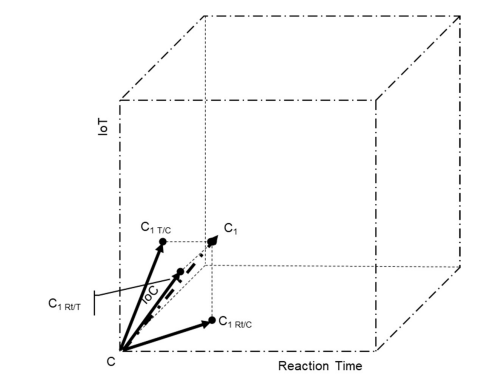
Regardless of the model used (2D or 3D), the total risk at any moment after the event materialises can be expressed by a simple but powerful vector equation. The total risk is the sum of the initial risk vector and the subsequent impact velocity vector scaled by the elapsed time:
Here, OC is the initial risk vector at the moment of occurrence, and ‘t’ is the time that has elapsed since the risk occurred. This simple equation transforms risk assessment from a static exercise into a predictive, time-based model of potential damage escalation, allowing for quantitative analysis of a developing crisis.
7. Conclusion and Future Directions
The author has attempted to present a fundamental evolution in risk assessment, arguing for a shift from a static, point-based methodology to a dynamic, vector-based model. By incorporating the temporal dimensions of Lead Time Velocity (LTV) and Impact Time Velocity (ITV) into a three-dimensional risk space, organisations can gain unprecedented insight into the true nature of threats. This approach moves beyond simply asking “what is the risk?” to answering the more critical questions of “how fast is it coming?” and “how quickly will the damage escalate?”
The primary advantages of adopting this 3D vector-based methodology are transformative, offering greater clarity, proactivity, and analytical rigour.
- Enhanced Visualisation: The model provides a more intuitive, pictorial view of risk positioning, magnitude, direction, and movement over time.
- Dynamic Assessment: It incorporates the crucial element of time through LTV and ITV, enabling more proactive and effective response planning.
- Improved Prioritisation: It allows for a clear differentiation between high-impact but low-velocity risks and lower-impact but high-velocity risks that require immediate attention.
- Quantitative Rigour: It opens the field of risk management to the application of advanced mathematics and geometry, providing a more robust and defensible foundation for analysis and decision-making.
The concepts presented here lay the groundwork for significant future development and practical application. Avenues for future work include:
- The development of a Risk Analysis software that could visually pinpoint risks within the 3D pyramids and model their vector trajectories in real-time.
- The application of the vector methodology to assess opportunities, modelling them as vectors that can be maximised rather than threats to be mitigated.
- The introduction of different axes to model other critical types of risk, such as those related to Safety, Environment, or Reputation, creates a truly multi-faceted risk model.
- Further research on the approach and the development of case studies, similar to that presented in Figure 3, which will cover implementation and practical examples of how this approach and possible framework will make a difference in the workplace and to teams during the RM workshops.
“By embracing the mathematics of vectors and the physics of velocity, this methodology has the potential to transform risk management — from a reactive, compliance-driven exercise into a truly predictive and strategic discipline.”
Ultimately, by embracing the mathematics of vectors and the physics of velocity, this methodology has the potential to transform risk management. It can elevate the practice from a reactive, compliance-driven exercise into a truly predictive and strategic discipline, empowering project leaders to navigate uncertainty with greater foresight and confidence.
References
Antoniadis, D.N. & Thorpe, A. (2003). Evaluation of risks using 3D Risk Matrix. In: Bontembi F. (ed) Systems-based Vision for Strategic and Creative Design. Vol. 3. pp. 2179–2184. Proceedings of 2nd International Conference of Structural and Construction Engineering. 23–26 September 2003, Rome, Italy.
APM (2019). Body of Knowledge, 7th Ed. Princess Risborough.
Osundahunsi, A. (2012). Effective project risk management using the concept of risk velocity, agility, and resiliency. Paper presented at PMI® Research and Education Conference, Limerick, Munster, Ireland. Newtown Square, PA: Project Management Institute.
Tattam, D. (2014). Risk Velocity. The third Dimension. Protecht. [Accessed on 25Nov25. https://www.youtube.com/watch?v=1zqwoKEnikI]
About the Author

Dr. Dimitris N. Antoniadis
 London, UK
Dr Dimitris N. Antoniadis PhD MSc BEng(1st) CEng FAPM FCMI MIMechE
Based in UK, has 35+ years’ experience in Programme and Project Management positions, having covered project phases from concept to handover and operation / maintenance.
He is currently Director in the Programme, Project Management and PMO with DANTON PROGM, technical advisor to Novacept and has set up the BSc in Project Control that is currently delivered by the partnership between London Metropolitan College and the University of West London.
He has held Senior Management posts in major utilities, infrastructure and construction organisations delivering programmes of works ranging from £250M to £3.2Bn. As Head of Programme Management Office (PMO) he has set up and run the departments within challenging partnering environments, setting up all the processes from governance to reporting. He has also led / co-led major business transformation programmes for Client organisations in UK and abroad, integrating project management software tools with ERP systems.
He is the author of the book ‘Demystifying Project Control’; contributed chapters in books on complexity, leadership and other project management topics and has written a number of journal and conference papers. He has been a guest speaker at UK Universities as well as International conferences on various project management topics.
He was awarded the PhD, from Loughborough University, UK, on the subject of ‘Managing Complexity in Project Teams’, where he developed a framework for managing the effects of complexity on projects.
Parts of his work can be seen in www.danton-progm.co.uk
His book Demystifying Project Control can be purchased from: https://amzn.to/2Jm1Zeh
Dr. Antoniadis can be contacted at dnanton00@gmail.com


