The PMO Memory Framework delivers a strategic approach to project governance and performance management by integrating real-time viz-boards, structured knowledge repositories, and advanced analytics into a single ecosystem. It enables senior leaders to make informed decisions by connecting standards, performance insights, and lessons learnt, ensuring continuous improvement and risk mitigation. By leveraging both tacit and explicit knowledge, the framework transforms fragmented data into actionable intelligence, driving efficiency, transparency, and alignment with organisational objectives. This model positions the PMO as a central hub for knowledge-driven decision-making and long-term value creation, thus creating and supporting the Centre of Excellence (CoE).
The "PMO Memory" framework is designed to integrate Knowledge Management (KM) and Visualisation Boards (Viz-boards) within a Project Management Office (PMO). The framework's purpose is to systematically capture, organise, visualise, and analyse project-related information.
The PMO Memory framework is structured around five core, interconnected zones: PMO Guidelines, Lessons Learnt (LL), Knowledge Management (KM), Directorate (or Company) Viz-boards, and Analytics. This structure creates a holistic ecosystem where foundational standards (Guidelines) inform project execution, which is monitored in near real-time (Viz-boards) and retrospectively captured (Lessons Learnt). This information is then consolidated within the Knowledge Management zone, which is further processed by the Analytics zone to generate high-level insights.
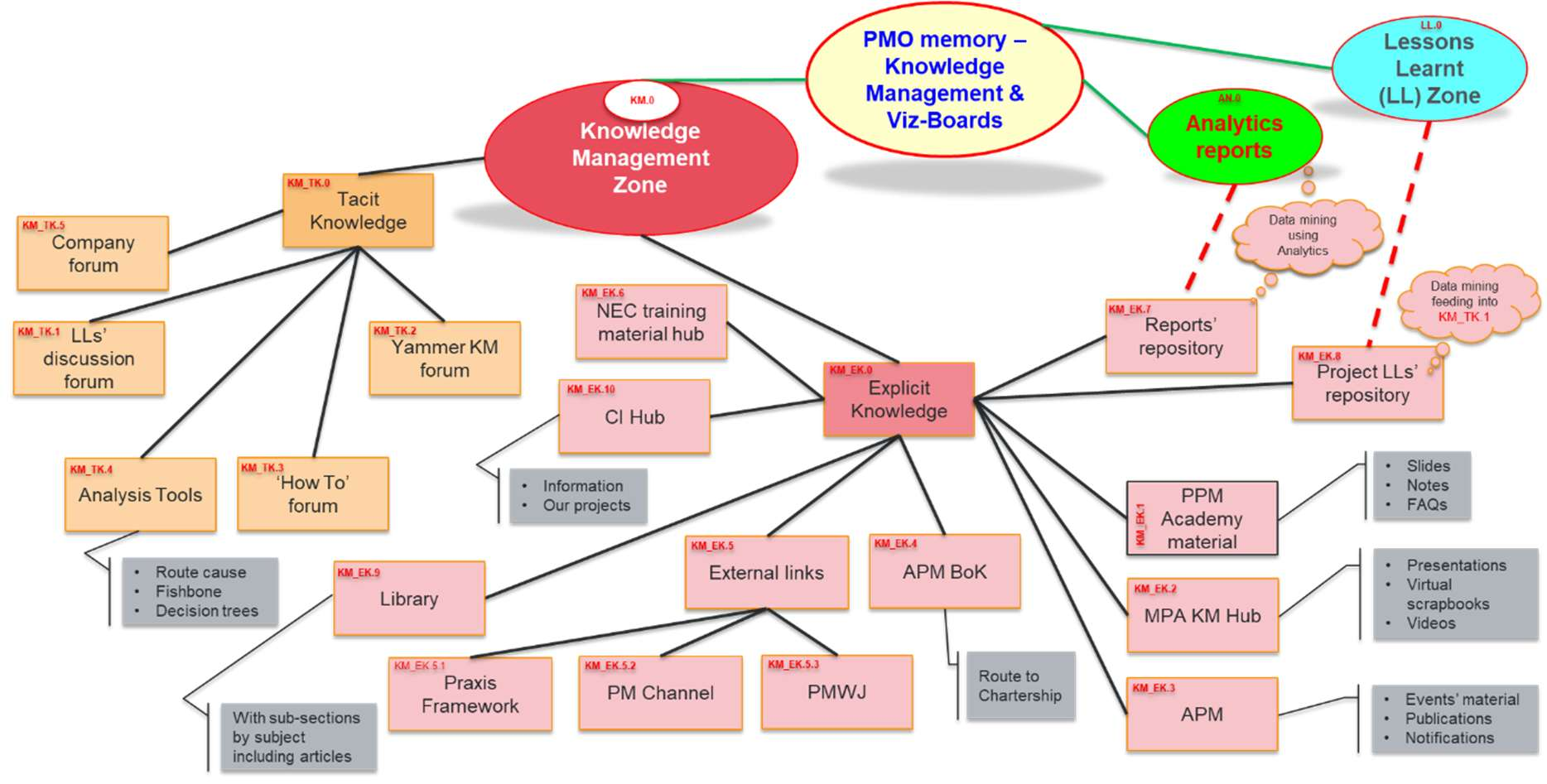
A key aspect of the framework is its detailed breakdown of the Knowledge Management zone, which segregates knowledge into Tacit and Explicit categories. Tacit knowledge is cultivated through collaborative platforms like forums, while Explicit knowledge is housed in structured repositories, frameworks, and learning hubs. The model emphasises dynamic information flows, including the use of data mining on reports and lessons learnt repositories to generate new insights, creating a continuous cycle of learning and improvement.
The PMO Memory framework offers a sophisticated, multi-layered approach to centralising and utilising a PMO's intellectual assets. It integrates governance, real-time data, historical experience, and analytical processing into a single, cohesive system. Figures 1 & 2 illustrate this as a mind map, which is detailed below.
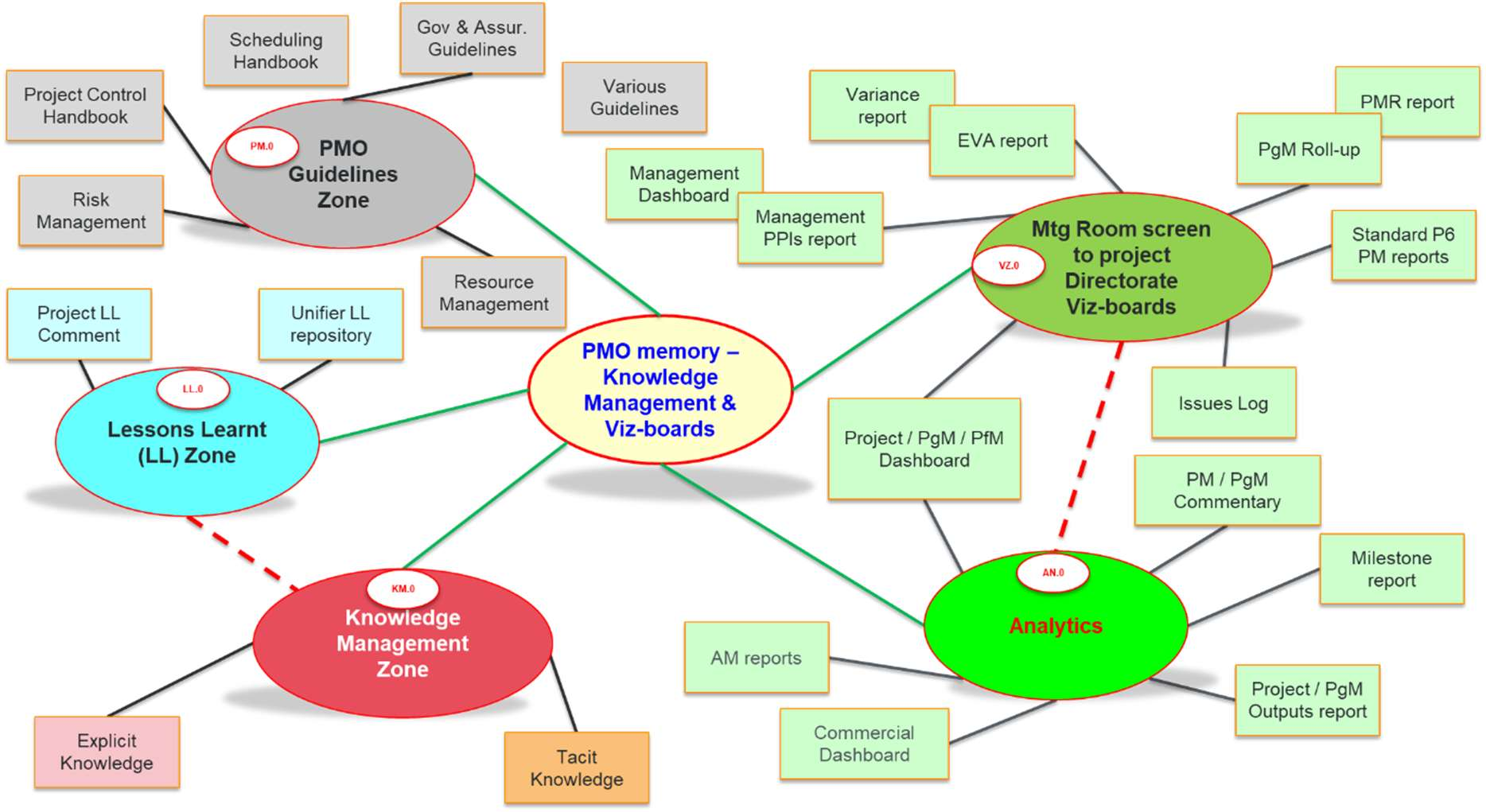
The model is organised into five primary zones, each with a distinct function contributing to the overall system.
This zone represents the foundational layer of governance and standards that guide project execution. It contains the official documentation defining processes, methodologies, and best practices.
Purpose: To provide a single source of truth for project control standards and assurance guidelines.
Sample Contents:
This zone is the primary interface for visualising project and programme of works performance data for senior management and directorates. It aggregates numerous reports into a consolidated view, likely presented on a meeting room screen.
Purpose: To provide a real-time, high-level dashboard of project and program status, performance, and key metrics.
Data Inputs:
This component is dedicated to the systematic capture of experiential knowledge gained during project lifecycles.
Purpose: To collect and store insights from past projects to prevent recurring mistakes and replicate successes.
Contents:
The Analytics zone acts as the data processing and insight-generation engine of the framework. It consumes data from other zones to produce higher-order intelligence.
Purpose: To perform analysis on project data to identify trends, create forecasts, and generate strategic insights.
Inputs & Outputs:
This is the central hub for storing and organising the PMO's collective knowledge. It serves as a bridge, integrating inputs from the Lessons Learnt zone and providing structured information for the Analytics zone. It encompasses both informal (Tacit) and formal (Explicit) knowledge.
The framework provides a detailed schematic of the Knowledge Management Zone (see Figure 2), breaking it down into two fundamental types of knowledge and their associated platforms, tools, and repositories.
This branch focuses on capturing and sharing informal, experience-based, and conversational knowledge that is often difficult to codify. The tools are primarily collaborative platforms that encourage discussion and peer-to-peer support.
| Category | Component | ID | Details |
|---|---|---|---|
| Discussion Forums | Company forum | KM_TK.5 |
General internal discussion platform. |
| LLs' discussion forum | KM_TK.1 |
A dedicated space for discussing lessons learnt. | |
| Yammer KM forum | KM_TK.2 |
Utilises the Yammer platform for KM-focused dialogue. | |
| "How To" forum | KM_TK.3 |
A practical forum for procedural questions and answers. | |
| Analysis Tools | Analysis Tools | KM_TK.4 |
Tools to structure problem-solving and investigation. Includes Root Cause analysis, Fishbone diagrams, and Decision trees. |
This branch deals with formal, codified, and documented knowledge. It comprises a wide array of internal repositories, external frameworks, professional body resources, and training materials.
| Category | Component | ID | Details |
|---|---|---|---|
| Internal Repositories | Reports' repository | KM_EK.7 |
Central storage for formal project reports. |
| Project LLs' repository | KM_EK.8 |
The formal database for documented lessons learnt. | |
| Library | KM_EK.9 |
A general library, potentially containing articles by subject. | |
| CI Hub | KM_EK.10 |
A hub for "Our projects" information. | |
| Training & Learning | PPM Academy material | KM_EK.1 |
Includes slides, notes, FAQs, presentations, virtual scrapbooks, and videos. |
| NEC training material hub | KM_EK.6 |
Hub for materials related to NEC contracts. | |
| MPA KM Hub | KM_EK.2 |
A knowledge hub related to the Major Projects Authority (MPA). | |
| External Resources | Praxis Framework | KM_EK.5.1 |
An integrated framework for project, programme, and portfolio management. |
| PM Channel | KM_EK.5.2 |
An external resource or media channel for project management. | |
| PMWJ | KM_EK.5.3 |
Referring to the PM World Library or Journal. | |
| APM BoK | KM_EK.4 |
The Association for Project Management's Body of Knowledge. | |
| Professional Bodies | APM / PMI | KM_EK.3 |
Resources from APM, including route to Chartership, event materials, publications, and notifications. |
The framework's strength lies in the defined connections between its components, creating a dynamic flow of information.
In addition to the two mind maps (Figures 1 & 2), the whole concept of the KM framework can be depicted by Figure 3 below.
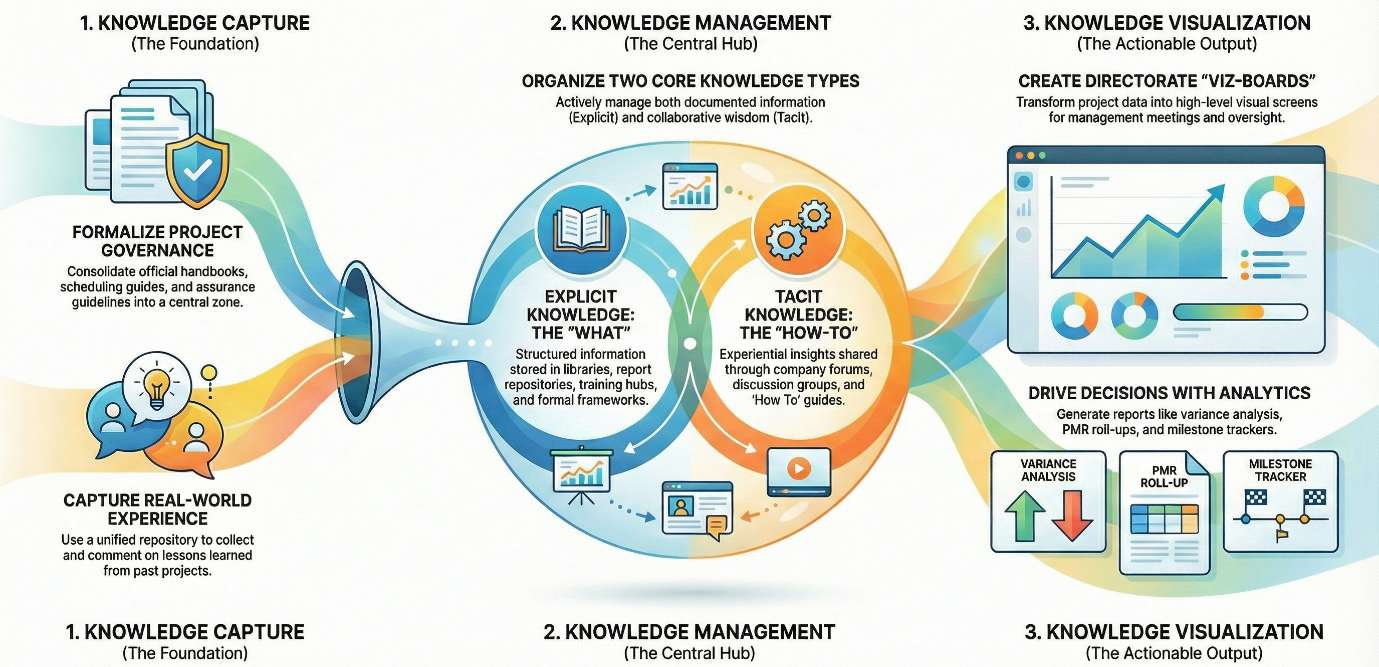
The PMO, through its CoE, together with the project control disciplines, can set this integrated approach at any organisational level. Wise set up and use of software tools, together with robust governance, allow for the integration of information generated by project control and project teams.

 Brazil


